24 July 2024
Company Liquidation in Slovenia
We assist in company liquidation in Slovenia. Our team of lawyers in Slovenia can act as liquidators and manage the entire dissolution process.
Company liquidation in Slovenia is the formal process of closing a business, due to various reasons. In order for a company to be closed, it must settle its debts, distribute any remaining assets, and deregister from the Slovenian Business Register. The process is overseen by the liquidator, who must ensure that all legal and financial obligations are met. Once the liquidation process in Slovenia is completed, the company ceases to exist as a legal entity. Our lawyers in Slovenia can act as liquidators and assist in all aspects of the company closure.
How can a company be liquidated in Slovenia?
The decision of company liquidation can be taken by the general meeting of the shareholders, the general members of a partnership or by the competent court in Slovenia. The company can be liquidated due to many reasons such as the expiration of the availability term, the inactivity of the management for more than six months, and the reduction of the capital below the limit stipulated by the law.
It can also be liquidated due to mergers or if the decision was taken by at least three quarters of the members of the company. The articles of association may stipulate other reasons for company liquidation in Slovenia and our team of Slovenian lawyers can advise on other reasons related to the liquidation of a company.
What are the steps for company liquidation in Slovenia?
The liquidation resolution initiates the company liquidation process in Slovenia. This resolution includes several key details such as: the company’s name and address, the entity responsible for making the liquidation decision, and the address where all claims should be submitted. It also specifies the deadline for submitting claims, which must be at least 30 days from the publication of the decision. Additionally, the resolution provides the name and address of the appointed liquidator. He/she is usually a former member of the management structure. He/she can be dismissed and replaced by a court’s order in case of a valid petition submitted by a debtor or a creditor.
Companies in the process of liquidation dealing with import-export activities will lose their EORI number, which is required for customs activities.
The video below offers further information on the company liquidation in Slovenia:
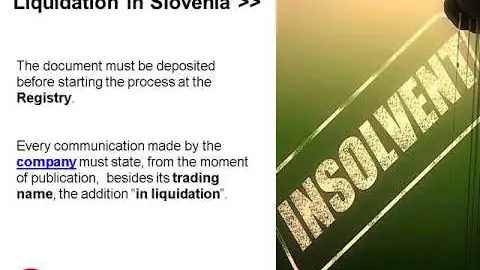
The liquidation resolution must be deposited before starting the process at the Registry. Each communication made by the company must state, from the moment of publication, besides its name, the addition “in liquidation”.
The responsibilities of a Slovenian liquidator
The liquidator must send a notification to all known creditors to register their claims. He/she is the person is in charge of with a set of activities, such as the following:
- appointing an individual to take care of company’s books and official documents after the liquidation;
- covering the company’s claims and recover the company’s debts;
- elaborating all the necessary documents for liquidation, such as the balance sheet and various reports;
- coordinating any business activity and register the liquidation ending to the competent authorities.
Once creditor claims are settled, it is possible to stop closing the company in Slovenia and resume business operations. This can happen if the company manages to resolve its financial issues. To do this, the company must submit a written notification to the Registry, signed by all shareholders or general partners.
If the company chooses to continue the liquidation process, the liquidator must prepare a new report detailing how the remaining assets will be distributed.
If it is approved, the process of distribution of assets shouldn’t take longer than 30 days. After that, the liquidator must notify the Registry to delete the company. He/she is released from his/her function and the company is officially not allowed to perform any activities under the previous name.
Besides the above procedure, the Slovenian investors may opt for a simplified company dissolution procedure. In this situation, if the dissolution is based on a decision from the general meeting, the company liquidation process in Slovenia may not be required. However, this is only possible if all shareholders declare in a notarised statement that all debts have been paid and assume liability for any remaining obligations, so all relevant information must be available, including the names of all creditors and the total value of outstanding liabilities that need to be settled.
How long does it take to liquidate a company in Slovenia?
The process of company liquidation depends on many factors such as the value of the claims, the available amounts necessary to cover these claims, and the degree of knowledge of the company’s creditors. It may take several years or, in the case of the simplified company dissolution procedure, it may take a few months.
When is it necessary to close a business in Slovenia?
As mentioned at the beginning of the article, there are several situations in which a company can be closed down. The liquidation of a company in Slovenia can be started through voluntarily or compulsory liquidation.
Voluntary liquidation is requested by the company’s representatives, following the requirements imposed by the Companies Act.
Compulsory liquidation is requested by a local court in Slovenia and it is implemented following the regulations prescribed by the Financial Operations, Insolvency Proceedings and Compulsory Dissolution Act (ZFPPIPP). At the same time, the Slovenian legislation on the matter prescribes a specific type of liquidation procedure available where the shareholders undertake to settle all debts, which is represented by the summary (shortened) procedure. In this case, the procedure is started by the company’s representatives through a notary in Slovenia.
In order to prevent bankruptcy, companies may enter compulsory composition, a procedure which can be handled only through the supervision of a court. This procedure involves signing an agreement regarding the reduction of the amount of liabilities and an extension on the deadline for the payment of such liabilities to the company’s creditors. The Companies Act prescribes regulations regarding the liquidation of a sole trader as well and our team of lawyers in Slovenia can provide further information on this matter.
Voluntary liquidation and bankruptcy proceedings in Slovenia
To initiate voluntary company liquidation in Slovenia, the shareholders must pass the liquidation resolution. The company is officially removed from the Register if it has no debts or if it can successfully pay them. However, if the liquidator discovers that the company does not have enough assets to cover its debts, the liquidation process will be replaced by bankruptcy proceedings. Our Slovenian lawyers will explain more about the bankruptcy proceedings.
These proceedings are governed by the Financial Operations, Insolvency Proceedings, and Compulsory Winding-Up Act. To close a company in Slovenia by filing for bankruptcy, you need to provide evidence of the company’s insolvency. Bankruptcy proceedings can also be initiated by creditors or by the Slovenian government authorities. The court makes a decision to start the process and appoints a bankruptcy manager. There are no structural or regulatory differences depending on who initiates the bankruptcy.
During bankruptcy proceedings, creditors are given a three-month period to submit their claims for repayment. After this period ends, the bankruptcy manager assesses and confirms the validity of these claims. Once the claims are settled, the next step involves selling the debtor’s assets to pay the debts.
Our law firm in Slovenia can assist in bankruptcy proceedings.
Voluntary company reorganization in Slovenia
Voluntary reorganization procedures like compulsory settlement proceedings are alternatives to winding up a company in Slovenia.
The compulsory settlement proceedings process is aimed at insolvent companies. To start this process, the company must show that it can continue operating and that creditors will get better repayment terms compared to a bankruptcy scenario.
The company needs to provide the court with several documents, including a report on its financial situation, an auditor’s opinion, and a restructuring plan. If the court approves these documents, the company can carry out regular business activities. Our attorneys in Slovenia can assist with company restructuring.
Through voluntary reorganization, companies can solve their financial problems and potentially recover. This way, they can avoid company liquidation in Slovenia, which means permanently closing the business.
Statistics about company liquidation in Slovenia
If you are interested in learning more about the closed companies in Slovenia in 2022 and 2023, our team of Slovenian lawyers has gathered some statistics on this subject:
- There were 832 registered company bankruptcies in 2022 and 532 as of August 2023;
- There were 68 registered sole proprietor bankruptcies in 2022 and 46 as of August 2023;
- 30 compulsory liquidation proceedings were registered in 2022;
- 56 voluntary liquidation proceedings were registered in 2022;
- 5 compulsory settlement proceedings were settled as of August 2023.
In addition to winding up companies in Slovenia, we also assist in immigration matters and company formation. We can also assist individuals looking for residency in Slovenia or Slovenian citizenship. For those who want to expand a business on the Slovenian market, our lawyers can provide legal assistance on immigration to Slovenia, as this step can be necessary for many third country nationals.
For more details regarding the liquidation of a company, you may contact our law firm in Slovenia. Our attorneys have the necessary expertise in the field to represent local and foreign investors.