8 July 2026
Obtain Citizenship in Slovenia
Discover the main legal options to obtain citizenship in Slovenia, including naturalization, and how our Slovenian lawyers can assist your application.
Foreigners who permanently relocate to Slovenia can have the right of becoming Slovenian citizens, if specific conditions are met. There are few legal options to acquire Slovenian citizenship and the most common refers to the naturalization process. Our law firm in Slovenia offers legal assistance and present to you all the legal requirements you must fulfill, depending on the characteristics of your case.
| Quick Facts | |
|---|---|
| How to obtain citizenship in Slovenia | By: – birth, – adoption, – naturalization |
Citizenship for individuals with Slovenian origins | Applicants up to the fourth degree of direct descent must have lived in Slovenia continuously for at least one year before applying for citizenship. |
Citizenship for refugees/stateless persons | Live in Slovenia for a continuous period of five years before applying for citizenship. |
| Conditions for citizenship by naturalization | – 10 years of residence in Slovenia, including 5 years of continuous residence before applying; – proficiency in Slovene language; – demonstrate good character; – show proof of financial self-sufficiency; – renounce the foreign citizenship. |
| Exceptional naturalization for national interest | Granted to individuals who present scientific, economic, cultural, social, national interest to Slovenia |
| Required documents for naturalization | – passport, – birth certificate, – proof document of living in Slovenia, – means of subsistence, – marriage certificate (if applicable), etc. |
| Citizenship for married foreigners | If a foreigner is married to a Slovenian citizen for at least three years, he/she can be naturalized after one year of residence. |
| Citizenship for Slovenian children born abroad | The child acquires Slovenian citizenship if registered as a Slovenian citizen (on application) before the age of 18, or if the person applies before the age of 36; The child must have at least one parent with Slovenian citizenship. |
| Citizenship for higher education studies in Slovenia | Foreigners who completed higher education studies must live in the country for at least seven years, including a continuous period of at least one year before applying for citizenship. |
| Revoking citizenship | If the individual holds a second nationality and engages in activities contrary to the international and other interests of Slovenia. |
| Conditions for residency by business investment | Register a business in Slovenia and invest 50,000 euros in paid-up capital; Residency by investment can lead to citizenship if certain criteria are met. |
| Residency by real estate investment | No such special program – Our attorneys will guide you through other ways of obtaining residency or citizenship. |
| Dual citizenship | Allowed, but restricted in some cases. |
| Advantages of obtaining Slovenian citizenship | – visa-free travel, – EU citizenship, – access to social services, – right to vote, – dual citizenship, etc. |
| Assistance | Our immigration lawyers in Slovenia will help interested individuals in obtaining citizenship, including preparing and submitting the required documents. |
| Law on citizenship | Citizenship Act |
Official fees charged for citizenship application | EUR 181, EUR 354 |
Minimum requirements for citizenship by marriage | Citizenship in Slovenia for foreigners married to Slovenian nationals can be acquired after 3 years of marriage and 1 year of stay in Slovenia. |
| Requirements for citizenship by descent | Citizenship by descent is available for descendants in direct line of up to the 4th degree. For these individuals, residency obligations appear (at least one year of residency before the application). |
| Fees charged for minor children citizenship application | The Slovenian law prescribes only the 2 fees mentioned above. |
| Duration of the citizenship process | The application for citizenship in Slovenia can be processed in around 12 months. |
| Dual citizenship | Foreigners acquiring citizenship by regular naturalisation must generally be released from their previous citizenship (exceptions apply, e.g. EU citizens where reciprocity exists, and extraordinary naturalisation). |
| Institution in charge with the review of the application | Citizenship in Slovenia is supervised by the Ministry of the Interior and Public Administration. |
| Fees for the issuance of a passport | EUR 58.87 (10-year passport, adults), EUR 52.07 (5-year passport, children of 3 to 18 years old), EUR 47.97 (3-year passport, children under 3 years), as of 1 June 2026 |
| Passport validity | 1/ 3/ 5/ 10 years |
| Difference between permanent residency and citizenship | A permanent resident is not allowed to vote in national elections (only in local elections) or to have a Slovenian passport. Outside of these, the rights of the 2 categories of individuals are the same. |
| Authentication/translation of foreign documents required (yes/no) | Yes |
| Citizenship ceremony (yes/no) | Yes |
| Citizenship certificate | The document is granted after the citizenship ceremony |
| How many foreigners received Slovenian citizenship? | 1,649 individuals (in 2023) |
How can an individual obtain Slovenian citizenship?
The main ways to acquire Slovenian citizenship are:
- by birth, when citizenship is acquired through Slovenian parents;
- by adoption, when a child is adopted by a Slovenian citizen and the legal conditions are met;
- by regular naturalization, after the foreigner has legally and continuously lived in Slovenia for the required period;
- by marriage to a Slovenian citizen, under more favorable residence conditions, if the marriage and residence requirements are met;
- by descent or Slovenian origin, for Slovenian descendants, expatriates or persons with a proven Slovenian family connection;
- by extraordinary naturalization, when granting citizenship is in Slovenia’s national interest, for example for scientific, economic, cultural, national or similar reasons.
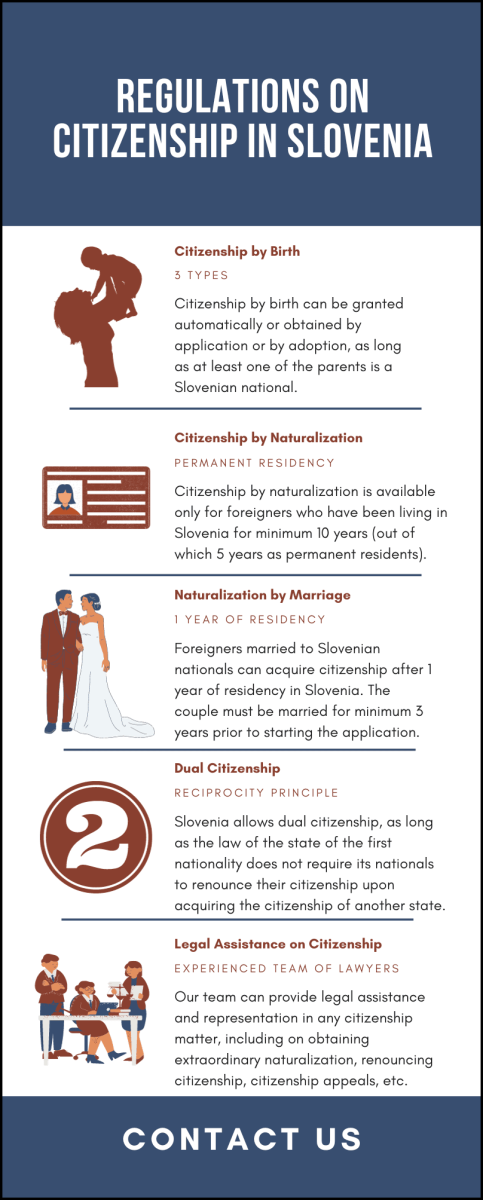
Below, our lawyers have prepared an infographic that presents some of the regulations on citizenship in Slovenia, available in 2026:
How can a foreigner obtain Slovenian citizenship by naturalization?
Foreigners can obtain Slovenian citizenship by naturalization after filing an application with the competent authorities and proving that they meet the legal conditions.
The process usually depends on the applicant’s residence in Slovenia, legal status and personal situation. Typically, the applicant will need to:
- check if the required residence period in Slovenia has been completed;
- prepare documents proving legal residence and identity;
- show proof of financial stability;
- prove knowledge of the Slovenian language;
- show that tax obligations have been fulfilled;
- provide a clean criminal record;
- submit the citizenship application to the competent administrative unit.
After the application is filed, the Slovenian authorities will review the documents and verify if all conditions are met. If the application is approved, the foreigner must take an oath of loyalty to Slovenia before citizenship is granted.
According to the Ministry of Interior of the Republic of Slovenia, a foreigner is generally entitled to citizenship if he or she has lived in this country for a period of minimum 10 years, including a continuous period of 5 years of residence prior to the application.
Our Slovenian lawyers can help foreigners throughout the naturalization process, from checking eligibility to preparing the application and supporting documents.
We invite you to watch a short presentation on obtaining citizenship in Slovenia:
What conditions must foreigners meet for obtaining citizenship by marriage?
Foreigners who are married to Slovenian citizens are entitled to apply for Slovene citizenship if the couple has been married for at least 3 years and the foreigner has actually lived in Slovenia continuously for at least 1 year before the application.
The applicant must still meet other legal conditions, such as:
- have legal residence status in Slovenia;
- meet the minimum age requirement, meaning that the applicant must be at least 18 years old;
- prove sufficient financial means to cover basic living expenses;
- prove knowledge of the Slovenian language;
- have fulfilled tax obligations in Slovenia;
- have no serious criminal convictions;
- not represent a threat to public order, security or the defence of Slovenia;
- take an oath of loyalty to Slovenia if the application is approved.
Our Slovenian immigration lawyers will help with the process of obtaining the citizenship by marriage.
How does a child acquire Slovenian citizenship by birth?
When we refer to citizenship by birth, Slovenia applies the principle of blood ties. This means that Slovenian citizenship is generally acquired through the parents, not simply through the place where the child is born.
A child automatically obtains Slovenian citizenship at birth in the following situations:
- if both parents are Slovenian citizens at the time of the child’s birth;
- if one parent is a Slovenian citizen and the child is born in Slovenia;
- if one parent is a Slovenian citizen, the other parent is unknown, of unknown citizenship or stateless, and the child is born abroad.
For children born in Slovenia,who have at least 1 Slovenian parent, the registration is done ex officio. This means that if you will have a child in 2026, as a parent, you do not have to take any additional steps to register the citizenship.
The situation is different when a child is born abroad and only one parent is a Slovenian citizen, while the other parent is a foreign national. In this case, the parents must apply for Slovenian citizenship on behalf of the child, before the child reaches the age of 18. If this was not done before the age of 18, the person may still acquire Slovenian citizenship by making a declaration before reaching the age of 36.
Please mind that persons who are Slovenian nationals and who were born abroad and who also hold the citizenshipof the other state can renounce Slovenian citizenship if they wish to do so prior to their 25th anniversary. For this, they need to write a declaration which can be submitted to a Slovenian consular mission/embassy.
What are the conditions for obtaining Slovenian citizenship by extraordinary naturalization?
Extraordinary naturalization is available when Slovenian citizenship is granted in the national interest of Slovenia.
It can apply to foreigners who have made or can make an important contribution in areas such as science, economy, culture, national interest or similar fields.
In general, the applicant must be at least 18 years old, have lived in Slovenia for at least 1 year and prove foreign national status, although these conditions may be waived in exceptional cases.
What is the law for Slovenian dual citizenship?
Slovenia is one of the countries that recognize dual citizenship. However, the Slovenian dual citizenship is limited by specific regulations.
For instance, in the case of a Slovenian national who is relocated to a foreign country where he or she wants to acquire citizenship, the Slovenian citizenship may be lost due to the national law of the said country.
Given that all countries have sovereignty over their national territories, if the law of a country imposes on a foreigner to give up his or her previous citizenship, then the Slovenian dual citizenship will not apply. However, in Slovenia, the national law generally requires (with exceptions, e.g. for EU citizens where reciprocity exists) a foreigner applying for regular naturalisation to renounce his or her nationality when obtaining Slovenian citizenship.
Our Slovenian lawyers can put you in touch with their partners in other countries, such as Italy, if you need information about obtaining citizenship in other states.
Please contact our law firm in Slovenia if you want to know more details regarding the ways in which a person can obtain citizenship in 2026.