26 May 2026
Immigrate to Slovenia
If you want to find out how to migrate to Slovenia, we invite you to contact our Slovenian lawyers, who can also offer legal representation.
If you want to migrate to Slovenia, we invite you to request in-depth legal advice on any immigration procedure from our team of Slovenian lawyers.
| Quick Facts | |
|---|---|
| Entry visa requirement (from EU) (YES/NO) | No |
Entry visa requirement (outside EU) (YES/NO) | Yes (certain visa exemptions can apply for nationals of certain countries arriving in Slovenia for short-term stays) |
Types of visas available in Slovenia | – C type visa (for short stays), – D type visa (for long-term stays) |
| Time frame for obtaining work visa (approx.) | Approximately 30 days |
| Validity of temporary residence permit | One can immigrate to Slovenia on a temporary visa for maximum 1 year. |
| Temporary residence permit renewal requirements | – identity document, – recent photograph, – proof of residence |
| Documents for obtaining a residence permit | In order to immigrate to Slovenia one must prepare: – the application form, – identity document/travel document, – recent photograph, – proof of health insurance, recognized in Slovenia, – clean criminal record issued in the home country, – proof of having sufficient financial means, – proof of fee payment, – documents attesting the purpose of stay |
| Time frame for obtaining permanent residence (approx.) | Permanent residence can be obtained after 5 years of stay in Slovenia. |
| Investor Visa availability | Residence by Investment Program |
| Start-up Visa Scheme availability (YES/NO) | No |
| Sponsorship requirement to immigrate to Slovenia (YES/NO) | Yes (but it depends on the visa program) |
| Time frame for obtaining citizenship | 10 years (by naturalization), but shorter periods of time are available for certain categories of persons |
| Citizenship/Residency by investment scheme availability (YES/NO) | Only residency by investment |
| Taxation of foreign citizens | The taxes due are calculated based on the residency (non-residents are charged only for the income obtained in Slovenia). |
| Tax benefits for expats | Benefits can arise from the provisions of double tax treaties, claiming local tax benefits and refunds for tax paid in excess. |
How can you assist me in immigration matters?
Our team of lawyers in Slovenia can offer legal assistance and representation to any foreigner who wants to relocate here. Our services include:
- assistance on the visa types and residence permits;
- information on the immigration procedures, documentation and institutions involved in the process;
- assistance in gathering the visa paperwork;
- assistance in applying for a residence permit;
- legal representation in visa appeals (foreigners whose applications were rejected have the right to appeal the decision in maximum 8 days since they have been officially informed).
Are there any immigration differences based on nationality?
The conditions for immigration to Slovenia can vary based on the nationality of the foreigner who arrives in this country. Thus, the Slovenian law distinguishes between nationals of the European Union (EU) member states, the European Economic Area (EEA) and third country nationals.
How can EU citizens migrate to Slovenia in 2026?
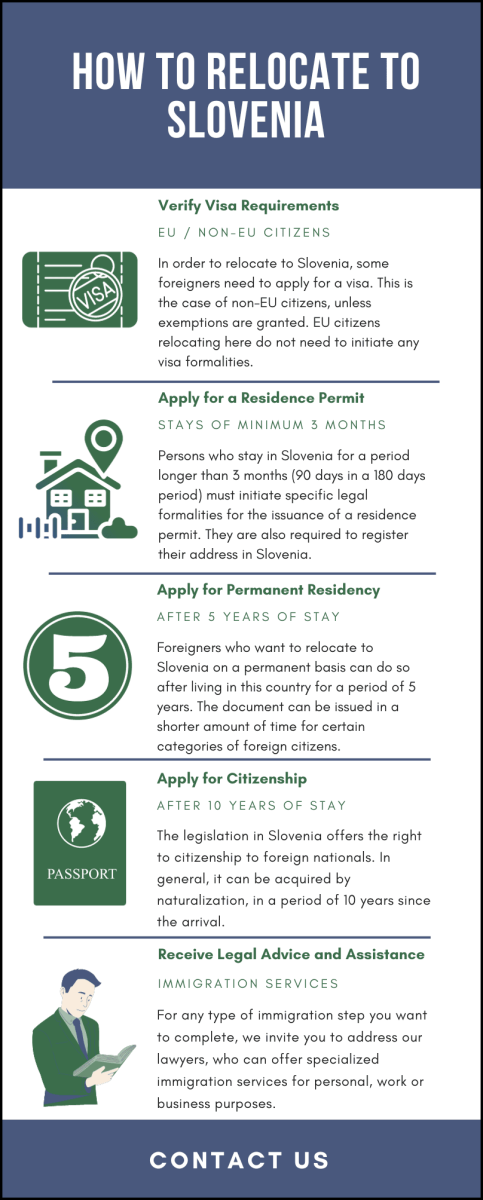
The citizens of the EU benefit from the simplest rules for immigration to Slovenia. This is given by the fact that Slovenia itself is a member state of the EU, a structure that guarantees the free movement of persons across its borders. This is why the procedure for immigration to Slovenia as an EU citizen is very simple – the foreigner does not need to apply for a visa to enter Slovenia. However, EU nationals who plan to stay long-term in Slovenia must apply for a residence registration certificate by the end of the first 90 days of stay in the country.
How can third party country nationals immigrate to Slovenia?
The procedures imposed on persons who arrive from third party countries (that do not have an immigration agreement with Slovenia and which most follow the standard immigration rules) are much more complex and they all involve the issuance of a visa, unless exempted in certain situations. Some of the basic rules are:
- the necessity to obtain a visa upon the arrival in Slovenia is imposed regardless of the purpose of stay;
- foreigners can apply for the C type visa, issued for short-term stays, or the D type visa, for long-term stays.
Below, you can find out the basics on how to relocate to Slovenia in 2026:
Are there any situations when third-party nationals can arrive visa-free in Slovenia in 2026?
Yes, for some third-party nationals visa-free arrivals are possible only for short-term stays, provided that their nationality is included in a visa waiver agreement. Some of the countries that benefit from this right are:
- the United States of America;
- Canada;
- Japan;
- Australia, etc.
On what legal grounds can I immigrate to Slovenia?
It is possible to immigrate to Slovenia for any of the reasons regulated by law. Foreigners can arrive here for:
- employment;
- business/ investment;
- family reunification;
- humanitarian purposes;
- study/ training;
- research, etc.
What are the main categories of visas issued in Slovenia?
The main categories of visas are established in accordance with the duration and the purpose of the stay – here, foreigners can arrive in Slovenia for transit purposes, for short-term or long-term stays.
Below, you can watch a video on immigration to Slovenia:

What documentation should I prepare for a work visa?
Applying for a Slovenian work visa includes preparing the required documents (passport, employment contract, health insurance, criminal record, etc.) and submitting the application, after paying the visa fees.
How long does it take to process my visa application in 2026?
The processing time varies in accordance with the type of visa you want to obtain – for instance, a C type visa can be processed in around 15 days. The longest processing time is 6 months (this is the maximum period of time you can expect for the processing of the residency by investment visa).
What are the main work permits I can obtain in Slovenia?
There are 4 types of work permits in Slovenia:
- single permit for work – for individuals with a valid work contract with a Slovenian employer;
- work visa for self-employed – for individuals owning a company in Slovenia;
- work visa for seasonal work;
- EU Blue Card – issued for highly qualified individuals in specific fields, with a two-year validity period.
How can I relocate to Slovenia as an investor?
If you are interested in immigration to Slovenia for investment purposes, you can participate in residency by investment program, provided that you meet the minimum qualifications imposed by this visa program. In the list below, our lawyers in Slovenia present some of the basic requirements:
- be able to invest at least EUR 50,000 in the Slovenian economy;
- start a new company, in which you will invest the required financial threshold in the first 6 months after the incorporation;
- create at least 1 new job (the employee must be a Slovenian or EU national);
- generate a monthly revenue of minimum EUR10,000.
What are the types of residence permits in Slovenia?
To acquire residency in Slovenia, you also need a residency permit. The two types are:
- temporary residence permit– initially valid for up to one year (up to two years for a single permit for work), but can be extended for up to three years, and renewed permits can be issued again on each expiry (for this type of permit you need a specific reason for your stay, such as a work permit or a student visa);
- permanent residence permit – it is valid for ten years and then renewable (to obtain it, you must have continuously lived in Slovenia with a temporary residence permit for five consecutive years).
If you need advice on relocating here, we invite you to contact our team of Slovenian lawyers.